On Finland’s winter coast, luxury reveals itself in peasant pies, empty saunas, and stars over the Arctic sky.
There once was a time when I equated luxury with skiing in the Alps, escaping to the Palm in Dubai, or exploring wine cellars in Sardinia. Before we started a family, my husband and I revelled in the luxury of sophisticated menus by starred chefs, extravagant interiors of exclusive five-star hotels, and Chanel and Dior shopping sprees.
Then we had three kids and realised luxury is something else entirely. It is a space without queues and crowds, without the need to pre-book every single indulgence of a holiday. To soak in the sun during the day, or let your eye rest on a monotonous landscape. It is good quality food, nutritious and filling, yet completely unsophisticated by Michelin standards.
I found luxury in a placinteria café in Chișinău, Moldova’s capital, or in a local coffee shop selling the most heavenly pistachio filled croissants in my beloved Kyiv, Ukraine. I found it in a golf resort on the border of England and Wales, where breakfast is served overlooking a dated green, but only two tables are served at a time and every guest is treated as family.
A trip to Finland feels like a testament to this revised definition – and it began with something as simple as a Karelian pie on our first morning in Kalajoki, a northern town along the Finnish coast towards the Gulf of Bothnia. Austere in appearance, presented as a small oval pastry with a thin rye crust folded around a filling of rice porridge, it hardly looks luxurious.
But it carries a long cultural memory: the pie originates from Karelia, a historic region that once belonged to the country but was largely ceded to the Soviet Union after World War II. The dish travelled west with displaced Karelians and eventually became part of the national table; today Karjalanpiirakka even holds EU protected designation status.
The pies are traditionally eaten with munavoi, or egg butter – a mixture of chopped boiled eggs and butter. Spread warm over the rice filling, it becomes unexpectedly comforting: earthy rye, soft rice, salt, butter. Peasant food in the most literal sense, simple, unembellished yet deeply satisfying – and there’s something disarming about the way it’s presented. Food eaten this way for generations, offered exactly as it is, a small act of unapologetic cultural candor.
Finland is chilled like that – metaphorically and literally speaking. Geography and demography help explain it: population density here is about 18 people per square kilometre, compared with 280 in the UK. What Finns would describe as a crowded space – think a queue to meet Santa around Christmas – is our daily norm in London.
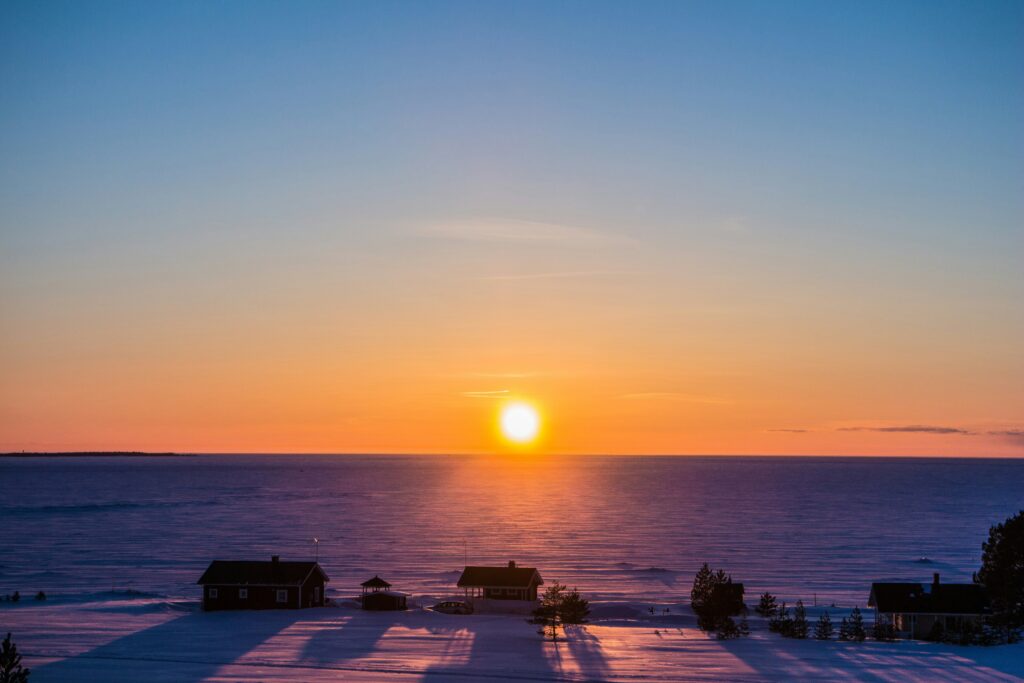
Kalajoki is popular as a summer seaside resort, its long sandy beaches and rows of holiday cottages filling with visitors when the Baltic warms. In winter, however, the same coastline settles into a different rhythm. The town acquires a meditative quiet that could easily be packaged as an upscale silent retreat at a Six Senses-style resort.
The difference is here, nothing is artificially engineered. The silence belongs to the landscape itself. The wind rolls freely across the vast frozen surface of the sea, and the horizon dissolves into a pale, misty grey. Visitors and locals seem to respect nature’s rules of conduct. Finns are famously comfortable with silence and distance; there is even a local joke that five metres is the appropriate conversational radius.

Marko Santapakka, our local guide and the owner of Safaritalo, the activity company that has shaped much of Kalajoki’s winter offering since the late 1990s, spoke very little. At times it felt as though our curiosity about the place was slightly puzzling to him, as if we were enquiring about something that did not particularly need explaining.
As the days went by and we spent more time with Marko, we grew accustomed to his economy of words. In fact, it became clear that his role was to support without intruding. He did not overwhelm us with facts or history, and there was never a sense that we were expected to do more, see more, move faster.
A former Finnish champion in cross-country skiing, Marko is widely regarded as one of the early architects of year-round tourism in the Hiekkasärkät area. While Kalajoki began as a coastal summer destination, the town now has snowmobile routes, ski tracks and guided excursions across the frozen Baltic, much of it developed under Marko’s watch.

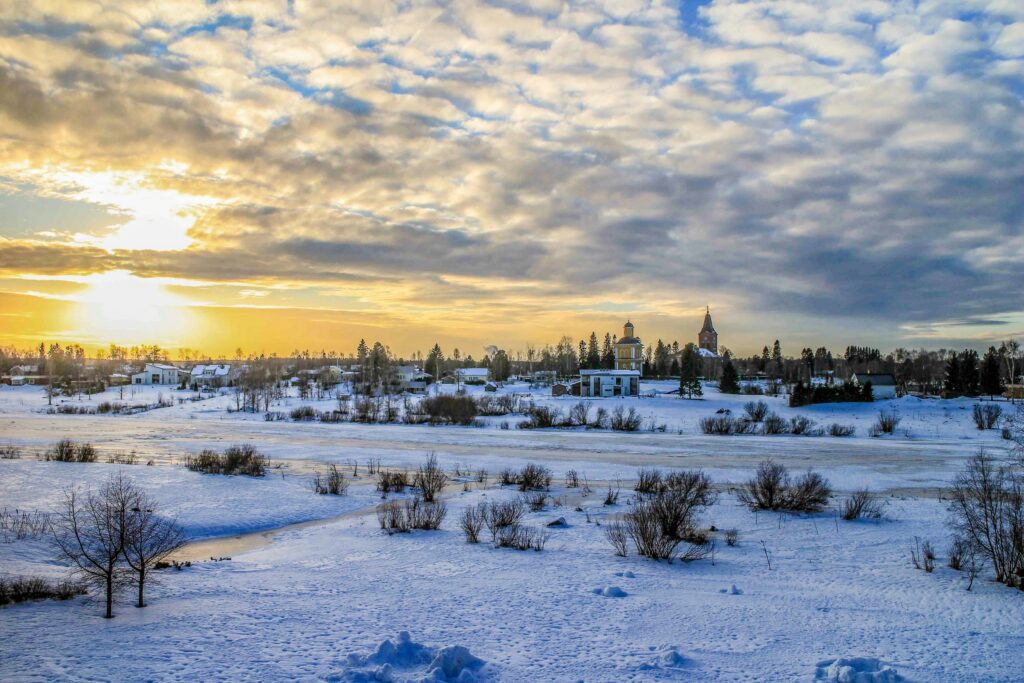
The snow here remains dry and powdery underfoot and, beneath the low Arctic sun, catches the light like a field of scattered diamonds. It also provides the perfect canvas for winter activities, all available almost at a whim: cross-country skiing, ice skating, ice fishing, fat biking and, of course, the purest winter fun of all: tobogganing, a beautifully exhausting activity for the kids which guarantees early bedtime and an evening for the parents.
But Kalajoki is also not the sort of place that greets you with a desk full of excursion leaflets. It offers only as much as you feel ready to take. You could easily spend an entire afternoon under the Charcot shower at SaniFani, the spacious spa centre, moving slowly between the jacuzzi and the sauna, where there is comfortably enough space for only 10 visitors.
The complex itself has the faint optimism of early-1990s leisure-centre architecture: tiled pools, glass mosaic walls and generous windows. What struck me was how few people were there – the calm never felt like the kind that follows decline. Everything was well maintained and the only thing absent was the crowds. But that only meant we were looked after with utmost care and attention – a bespoke experience if there ever was one.

One evening Marko invited us on a snowmobile ride across the frozen seascape. We were given windproof overalls and helmets which made us look like astronauts in spacesuits. Snug inside a makeshift sleigh attached to the snowmobile, we drifted across the ice and faded into the darkness under the vault of stars.
There’s an absence of light pollution this far north; it lets us metropolis folk, blinded by city lights, see the sky above in a completely different dimension and depth. Pulling into a pit stop, Marko built a small fire, retrieving flasks of hot cacao from a thermal bag and handing out warm reindeer pies prepared fresh by Safaritalo’s chef.
We had hoped to see the Northern Lights, the great Arctic spectacle. But clouds lingered low on the horizon and the sky never quite cleared. In the end it didn’t like a disappointment – only a reason to return.

Daria Partas is the founder of Partas Global, a London-based boutique advisory specialising in UHNW communications and reputation management.