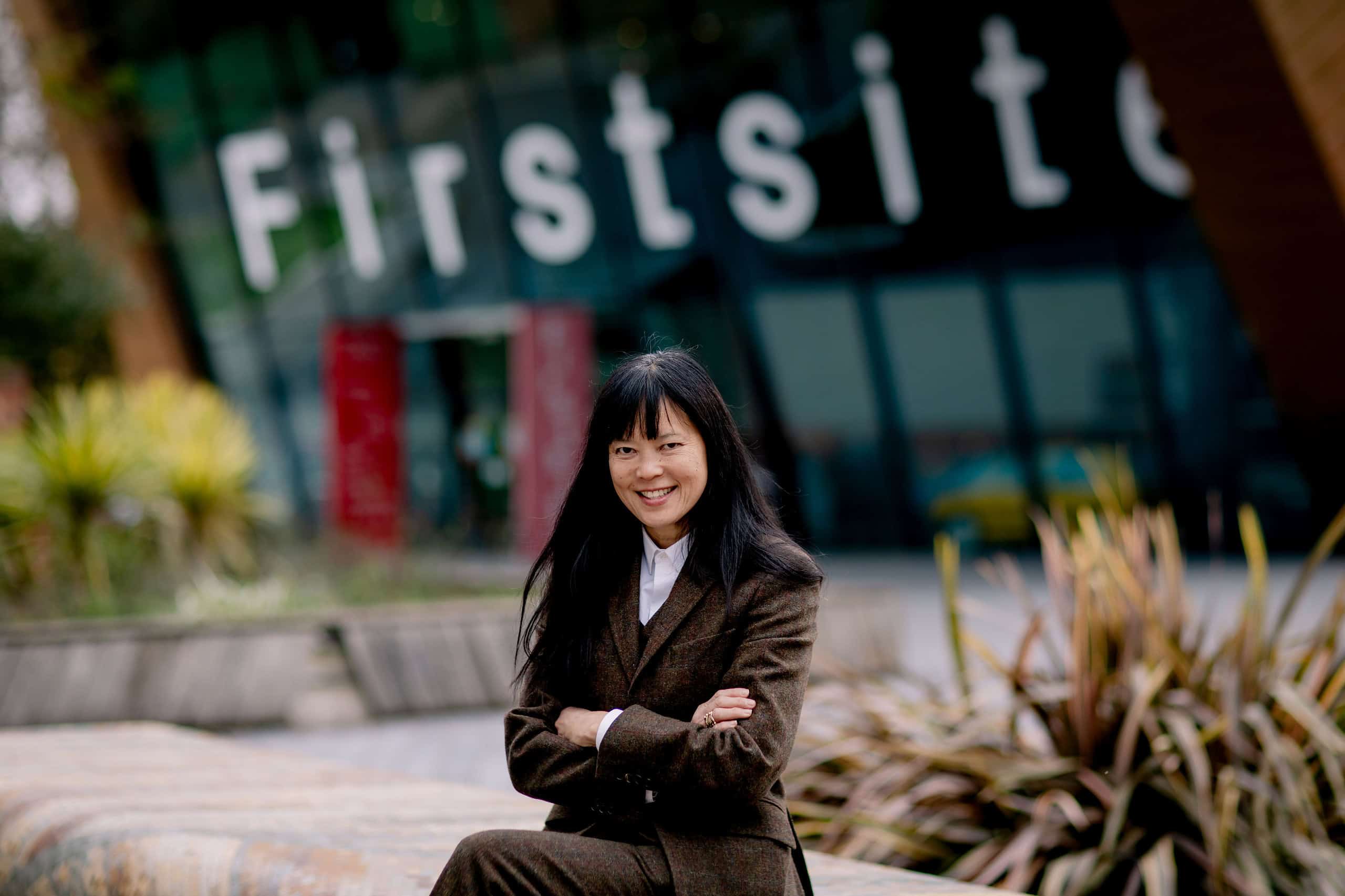
Joanne Ooi has always lived at the crossroads of culture and reinvention. Born in the U.S. to Chinese Singaporean parents, the trained lawyer became a trailblazing force in Hong Kong’s fashion and creative scenes: first as Creative Director of Shanghai Tang, then founder of jewelry retailer Plukka. The cultural maven opened Ooi Botos Art Gallery and then became a bold voice in environmental advocacy founding the city’s Clean Air Network with Christine Loh.
Today, she is between London and the pastoral quiet of Suffolk, England, where she’s channeled her passion for all things arts and culture into her new project: the annual EA Festival—a vibrant annual event dedicated to cultural, intellectual dialogue and artistic expression.
“It’s about bringing world class thought leadership and creativity to the countryside, while adapting it to the interests and preoccupations of regional audiences” says Ooi. Last year she launched a version of EA festival in Albania entitled Freedom & Transformation. In between annual festivals, she’s moderating talks at the Tate, creating local events around sustainability or busy scoping out cultural gems less travelled across the UK and Europe, most recently Crete and Cairo.
While East Anglia offers her the space to relax and recalibrate, Ooi’s past lives in Hong Kong and New York still inform some of her favorite destinations—whether it’s a quirky local artist studio, the perfect little restaurant, a pilgrimage-worthy wine bar, or a hidden gallery with a global soul.

Go-to neighborhood ritual?
After decades in Hong Kong, I now live in the English countryside, East Anglia, on the border of Suffolk and Essex. have a favourite pub walk that starts from St. Stephen’s Chapel in Bures and ends at The Angel Inn in Stoke by Nayland. St. Stephen’s Chapel is a little-known gem of a church that contains the caskets of some of the Earls of Oxford, dating back hundreds and hundreds of years, and is off the beaten tourist path. The chapel is tiny to boot, meaning that you can look at these caskets up close and undisturbed, a hushed and awe-inspiring experience, considering their contents and age, not to mention pristine condition. The chapel also overlooks an impressive piece of land art, the Bures Dragon. The walk to the pub takes about 2 hours and takes you through pretty countryside and villages. And the Angel Inn is hands-down one of the best restaurants in East Anglia and a fitting reward for your exertions.
Best-kept secret in Suffolk?
That secret is in a town a few miles down the road from where I live. It is a state of the art weaving mill that creates jacquard fabrics for some of the best designer brands in the world: Stephen Walters, based in Sudbury. It’s managed to remain a family business for generations, despite all of its competitors in South Suffolk going out of business. Sudbury and environs were historically a centre of silk weaving but, slowly, the factories went out of business after being outcompeted by textile factories in China, Italy etc. Stephen Walters has not just managed to remain afloat but continues to flourish, due to its investment in the latest technology.
Favourite neighbourhoods and venues in London?
Definitely East London. I rarely go past Tottenham Court Road on the Elizabeth line, if I can help it. I’m the kind of person who rarely frequents a restaurant twice, on purpose. Life is simply too short for that but, for convenience, of course, I have some regular haunts. These are The Delaunay (schnitzel always), Plaza Khao Gaeng (the most authentic Thai restaurant in London, based on my experience of having a Thai housekeeper for 20 years) and Kanada-ya on Foubert Place (the best location of this very respectable ramen chain, an oasis in the middle of frenetic Carnaby Street). My favourite non-canteen restaurants are Imperial China (as good as many top-rank Cantonese restaurants in Hong Kong), 64 Goodge Street (a new restaurant by Portland), Bellamy’s (impeccably prepared traditional British food) and Oren (in Dalston).

A store you always visit when in London?
Choosing Keeping, the stationery store with lots of limited-run cloth-bound notebooks, Japanese paper products and fountain pens. Another outstanding retail operation is the very edgy and tightly curated store at the Design Museum. Save for stationery, which obsesses me, I’ve stopped shopping since moving to the country. I’m 57 years old, so if I acquire a piece of clothing, I ask myself, how many more times will I wear that before I die?
One item you always bring back from Hong Kong?
Dragon Well tea leaves
Favourite museum/gallery anywhere in the world?
Wow, this is an enormously difficult question, since I’m a constant museum goer. But, pushed for an answer, it is the Kunsthaus Zurich. The buildings and exhibition design are fantastic, as is their collection of modern and contemporary art, not to mention the biggest museum collection of Giacometti in the world. I love this museum because every single object and display are world class but the overall scale is not overwhelming and the condition, upkeep and organisation of the museum are impeccable – Swiss-style! You come away feeling refreshed and uplifted.

My other two big art recommendations are the Setouchi Triennial held in a far-flung archipelago of islands in Japan. A group of disparate parties wanted to revitalise this cluster of islands which, like most of Japan’s non-urban areas, was suffering from aging and depopulation, and founded this triennial to repurpose these islands. It’s a real pain to get there. But worth it – for the quality of the art and the overall experience of being transported to another world.
For another type of crazy magic carpet ride, this time into the future, visit Ars Electronica, the grand-daddy of media art fairs. It has been championing all forms of technological art for decades and the main site is a gigantic former postal sorting centre in the middle of Linz, Austria. It is the most mind-expanding, non-commercial art excursion imaginable. I made a video explaining, What is Media Art, during my first trip there 5 years ago.
Travel splurge you’ll never regret?
Staying at Amanjiwo, next to Borobudur temple in Central Java, Indonesia, near the time of its opening, many years ago.

Where do you go for total escapism?
The best place and way to relax is to just visit a friend’s house abroad. Then, there’s no tourism agenda and I can just spend my days on the sofa, reading and napping.
Best hotel you’ve ever stayed at?
It would be an Aman hotel from the 2000s, before it was acquired by its present owner, before the mass popularization of boutique hotels. And, from that hotel group, the original property, Amanpuri, still stands out.
If you took EA festival truly global, which cities would be on the wishlist?
Tangier, Kosovo, Wroclaw – I like off the beaten path. But with direct air connections from London! I haven’t actually been to Warsaw but, considering Poland’s economic growth rate, it would astound festival visitors from abroad.
What’s always in your suitcase, no matter where you’re heading?
I hate being caught out without a book. Plus, I carry around old copies of the New York Review of Books obsessively. I consider them my most important intellectual reference, both personally and professionally. To my mind, there is no other publication of its quality, exigency or commitment to the liberal arts.
What are you currently reading?
White Throat, a crime fiction novel set in Colchester by friend James Gurbutt (pen name: James Henry) and a biography of Leigh Bowery by Sue Tilley. I’m interviewing Sue at an EA Festival event at Tate Modern in less than 2 weeks. After that, I will read Fuchsia Dunlop’s Invitation to a Banquet and Rebecca Willis’ Life, Death & Getting Dressed, because I’m interviewing them at EA Festival on 14-15 June.
Dream destination, not yet fulfilled?
Since I’ve already attended all 4 tennis Grand Slams, it would have to be Inhotim, the Brazilian art park, or MONA (the Museum of Old and New Art) in Tasmania.